5 Set Theory
5.1 Sets and Operations on Sets
5.1.1 Beginning Activity 1 (Set Operations)
Before beginning this section, it would be a good idea to review sets and set notation, including the roster method and set builder notation, in Section 2.3.
In Section 2.1, we used logical operators (conjunction, disjunction, negation) to form new statements from existing statements. In a similar manner, there are several ways to create new sets from sets that have already been defined. In fact, we will form these new sets using the logical operators of conjunction (and), disjunction (or), and negation (not). For example, if the universal set is the set of natural numbers and
-
•
The set consisting of all natural numbers that are in and are in is the set ;
-
•
The set consisting of all natural numbers that are in or are in is the set ; and
-
•
The set consisting of all natural numbers that are in and are not in is the set .
These sets are examples of some of the most common set operations, which are given in the following definitions.
Definition. Let and be subsets of some universal set . The intersection of and , written and read " intersect ," is the set of all elements that are in both and . That is,
The union of and , written and read " union ," is the set of all elements that are in or in . That is,
Definition. Let and be subsets of some universal set . The set difference of and , or relative complement of with respect to , written and read " minus " or "the complement of with respect to ," is the set of all elements in that are not in . That is,
The complement of the set , written and read "the complement of ," is the set of all elements of that are not in . That is,
For the rest of this beginning activity, the universal set is , and we will use the following subsets of :
So in this case, and . Use the roster method to specify each of the following subsets of .
-
1.
-
2.
-
3.
We can now use these sets to form even more sets. For example,
Use the roster method to specify each of the following subsets of .
-
1.
-
2.
-
3.
-
4.
5.1.2 Beginning Activity 2 (Venn Diagrams for Two Sets)
In Beginning Activity 1, we worked with verbal and symbolic definitions of set operations. However, it is also helpful to have a visual representation of sets. Venn diagrams are used to represent sets by circles (or some other closed geometric shape) drawn inside a rectangle. The points inside the rectangle represent the universal set , and the elements of a set are represented by the points inside the circle that represents the set. For example, Figure 5.1 is a Venn diagram showing two sets.
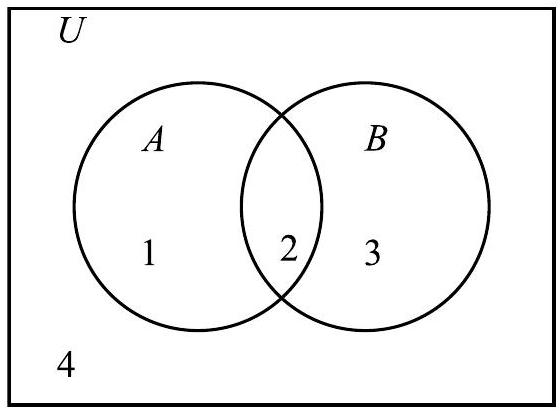
In Figure 5.1, the elements of are represented by the points inside the left circle, and the elements of are represented by the points inside the right circle. The four distinct regions in the diagram are numbered for reference purposes only. (The numbers do not represent elements in a set.) The following table describes the four regions in the diagram.
| Region | Elements of | Set |
|---|---|---|
| 1 | In and not in | |
| 2 | In and in | |
| 3 | In and not in | |
| 4 | Not in and not in |
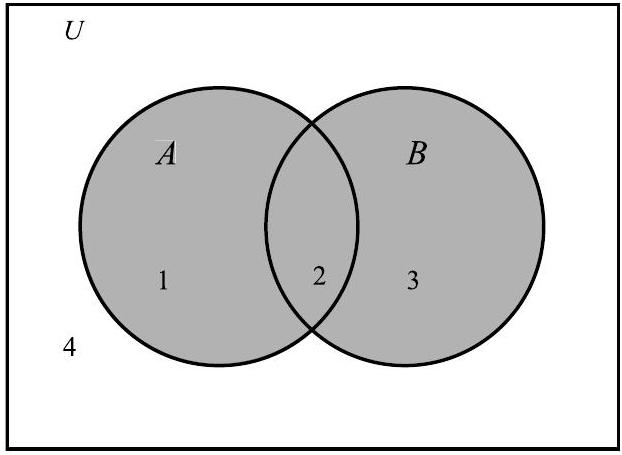
We can use these regions to represent other sets. For example, the set is represented by regions 1, 2, and 3 or the shaded region in Figure 5.2.
Let and be subsets of a universal set . For each of the following, draw a Venn diagram for two sets and shade the region that represent the specified set. In addition, describe the set using set builder notation.
-
1.
-
2.
-
3.
-
4.
-
5.
-
6.
5.1.3 Set Equality, Subsets, and Proper Subsets
In Section 2.3, we introduced some basic definitions used in set theory, what it means to say that two sets are equal and what it means to say that one set is a subset of another set. See the definitions from that section. We need one more definition.
Definition. Let and be two sets contained in some universal set . The set is a proper subset of provided that and . When is a proper subset of , we write .
One reason for the definition of proper subset is that each set is a subset of itself. That is,
However, sometimes we need to indicate that a set is a subset of but . For example, if
then . We know that since each element of is an element of , but since and . (Also, and .) Notice that the notations and are used in a manner similar to inequality notation for numbers and .
It is often very important to be able to describe precisely what it means to say that one set is not a subset of the other. In the preceding example, is not a subset of since there exists an element of (namely, 0) that is not in .
In general, the subset relation is described with the use of a universal quantifier since means that for each element of , if , then . So when we negate this, we use an existential quantifier as follows:
So we see that means that there exists an in such that and .
Notice that if , then the conditional statement, "For each , if , then " must be true since the hypothesis will always be false. Another way to look at this is to consider the following statement:
However, this statement must be false since there does not exist an in . Since this is false, we must conclude that . Although the facts that and may not seem very important, we will use these facts later, and hence we summarize them in Theorem 5.1.
Theorem 5.1. For any set and .
In Section 2.3, we also defined two sets to be equal when they have precisely the same elements. For example,
If the two sets and are equal, then it must be true that every element of is an element of , that is, , and it must be true that every element of is
an element of , that is, . Conversely, if and , then and must have precisely the same elements. This gives us the following test for set equality:
Theorem 5.2. Let and be subsets of some universal set . Then if and only if and .
5.1.4 Progress Check 5.3 (Using Set Notation)
Let the universal set be , and let
In each of the following, fill in the blank with one or more of the symbols , , or so that the resulting statement is true. For each blank, include all symbols that result in a true statement. If none of these symbols makes a true statement, write nothing in the blank.
5.1.5 More about Venn Diagrams
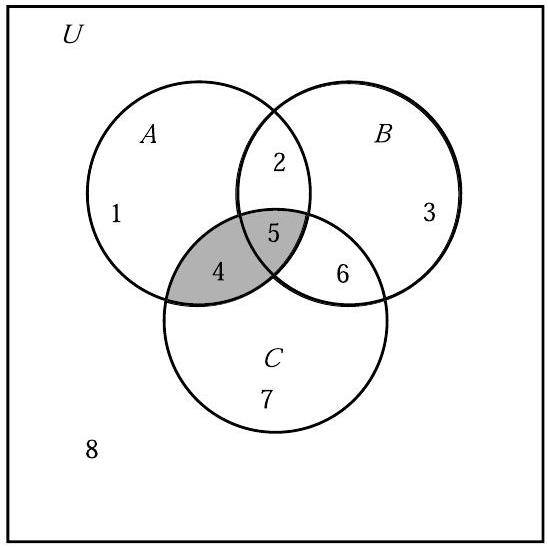
In Beginning Activity 2, we learned how to use Venn diagrams as a visual representation for sets, set operations, and set relationships. In that activity, we restricted ourselves to using two sets. We can, of course, include more than two sets in a Venn diagram. Figure 5.3 shows a general Venn diagram for three sets (including a shaded region that corresponds to ).
In this diagram, there are eight distinct regions, and each region has a unique reference number. For example, the set is represented by the combination of regions 1, 2, 4, and 5, whereas the set is represented by the combination of regions 4,5,6, and 7. This means that the set is represented by the combination of regions 4 and 5. This is shown as the shaded region in Figure 5.3.
Finally, Venn diagrams can also be used to illustrate special relationships between sets. For example, if , then the circle representing should be completely contained in the circle for . So if , and we know nothing about
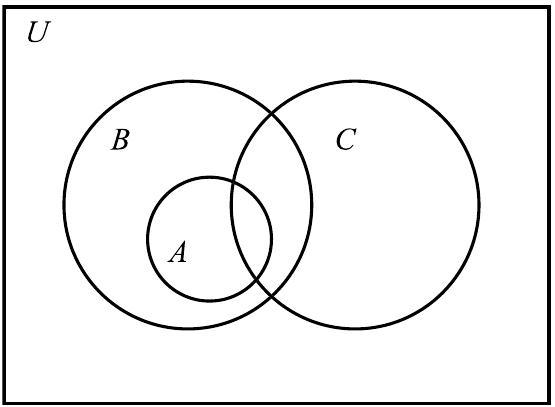
any relationship between the set and the sets and , we could use the Venn diagram shown in Figure 5.4.
5.1.6 Progress Check 5.4 (Using Venn Diagrams)
Let , and be subsets of a universal set .
-
1.
For each of the following, draw a Venn diagram for three sets and shade the region(s) that represent the specified set.
-
(a)
-
(b)
-
(c)
-
(d)
-
(a)
-
2.
Draw the most general Venn diagram showing .
-
3.
Draw the most general Venn diagram showing .
5.1.7 The Power Set of a Set
The symbol is used to describe a relationship between an element of the universal set and a subset of the universal set, and the symbol is used to describe a relationship between two subsets of the universal set. For example, the number 5 is an integer, and so it is appropriate to write . It is not appropriate, however, to write since 5 is not a set. It is important to distinguish between 5 and . The difference is that 5 is an integer and is a set consisting of one element. Consequently, it is appropriate to write , but it is not appropriate to write . The distinction between these two symbols (5 and ) is important when we discuss what is called the power set of a given set.
Definition. If is a subset of a universal set , then the set whose members are all the subsets of is called the power set of . We denote the power set of by . Symbolically, we write
That is, if and only if .
When dealing with the power set of , we must always remember that and . For example, if , then the subsets of are
| (1) |
We can write this as
Now let . Notice that . We can determine the subsets of by starting with the subsets of in (1). We can form the other subsets of by taking the union of each set in (1) with the set . This gives us the following subsets of .
| (2) |
So the subsets of are those sets in (1) combined with those sets in (2). That is, the subsets of are
| (3) |
which means that
Notice that we could write
Also, notice that has two elements and has four subsets, and has three elements and has eight subsets. Now, let be a nonnegative integer. The following result can be proved using mathematical induction. (See Exercise 17.)
Theorem 5.5. Let be a nonnegative integer and let be a subset of some universal set. If the set has elements, then the set has subsets. That is, has elements.
5.1.8 The Cardinality of a Finite Set
In our discussion of the power set, we were concerned with the number of elements in a set. In fact, the number of elements in a finite set is a distinguishing characteristic of the set, so we give it the following name.
Definition. The number of elements in a finite set is called the cardinality of and is denoted by .
For example, .
Theoretical Note: There is a mathematical way to distinguish between finite and infinite sets, and there is a way to define the cardinality of an infinite set. We will not concern ourselves with this at this time. More about the cardinality of finite and infinite sets is discussed in Chapter 9.
5.1.9 Standard Number Systems
We can use set notation to specify and help describe our standard number systems. The starting point is the set of natural numbers, for which we use the roster method.
The integers consist of the natural numbers, the negatives of the natural numbers, and zero. If we let , then we can use set union and write
So we see that , and in fact, .
We need to use set builder notation for the set of all rational numbers, which consists of quotients of integers.
Since any integer can be written as , we see that .
We do not yet have the tools to give a complete description of the real numbers. We will simply say that the real numbers consist of the rational numbers and the irrational numbers. In effect, the irrational numbers are the complement of the set of rational numbers in . So we can use the notation and write
A number system that we have not yet discussed is the set of complex numbers. The complex numbers, , consist of all numbers of the form , where and (or ). That is,
We can add and multiply complex numbers as follows: If , then
5.1.10 Exercises for Section 5.1
-
1.
Assume the universal set is the set of real numbers. Let
Respond to each of the following questions. In each case, explain your answer.
-
(a)
Is the set equal to the set ?
-
(b)
Is the set a subset of the set ?
-
(c)
Is the set equal to the set ?
-
(d)
Is the set a subset of the set ?
-
(e)
Is the set a subset of the set ?
-
(a)
-
2.
-
(a)
Explain why the set is equal to the set .
-
(b)
Explain why the set is equal to the set .
-
(a)
-
3.
Assume that the universal set is the set of integers. Let
In each of the following, fill in the blank with one or more of the symbols , , or so that the resulting statement is true. For each blank, include all symbols that result in a true statement. If none of these symbols makes a true statement, write nothing in the blank.
-
4.
Write all of the proper subset relations that are possible using the sets of numbers , and .
-
5.
For each statement, write a brief, clear explanation of why the statement is true or why it is false.
-
(a)
The set is a subset of .
-
(b)
The set is equal to is even and .
-
(c)
The empty set is a subset of .
-
(d)
If , then the set is a subset of .
-
(a)
-
6.
Use the definitions of set intersection, set union, and set difference to write useful negations of these definitions. That is, complete each of the following sentences
-
(a)
if and only if ….
-
(b)
if and only if ….
-
(c)
if and only if ….
-
(a)
-
7.
Let , and let
,
,
,
.Use the roster method to list all of the elements of each of the following sets.
-
(a)
-
(b)
-
(c)
-
(d)
-
(e)
-
(f)
-
(g)
-
(h)
-
(i)
-
(j)
-
(k)
-
(l)
-
(m)
-
(n)
-
(a)
-
8.
Let , and let
,
is odd ,
is a multiple of 3,
is even .Use the roster method to list all of the elements of each of the following sets.
-
(a)
-
(b)
-
(c)
-
(d)
-
(e)
-
(f)
-
(g)
-
(h)
-
(i)
-
(j)
-
(k)
-
(l)
-
(a)
-
9.
Let , and be subsets of a universal set . Assume that .
-
(a)
Complete the following sentence:
For each , if , then .
-
(b)
Write a useful negation of the statement in Part (9a).
-
(c)
Write the contrapositive of the statement in Part (9a).
-
(a)
-
10.
Let be the universal set. Consider the following statement:
For all and that are subsets of , if , then .
-
(a)
Identify three conditional statements in the given statement.
-
(b)
Write the contrapositive of this statement.
-
(c)
Write the negation of this statement.
-
(a)
-
11.
Let , and be subsets of some universal set . Draw a Venn diagram for each of the following situations.
-
(a)
-
(b)
-
(c)
, and
-
(d)
, and
-
(a)
-
12.
Let , and be subsets of some universal set . For each of the following, draw a general Venn diagram for the three sets and then shade the indicated region.
-
(a)
-
(b)
-
(c)
-
(d)
-
(e)
-
(f)
-
(a)
-
13.
We can extend the idea of consecutive integers (See Exercise (10) in Section 3.5) to represent four consecutive integers as , and , where is an integer. There are other ways to represent four consecutive integers. For example, if , then , and are four consecutive integers.
-
(a)
Prove that for each is the sum of four consecutive integers if and only if .
-
(b)
Use set builder notation or the roster method to specify the set of integers that are the sum of four consecutive integers.
-
(c)
Specify the set of all natural numbers that can be written as the sum of four consecutive natural numbers.
-
(d)
Prove that for each is the sum of eight consecutive integers if and only if .
-
(e)
Use set builder notation or the roster method to specify the set of integers that are the sum of eight consecutive integers.
-
(f)
Specify the set of all natural numbers can be written as the sum of eight consecutive natural numbers.
-
(a)
-
14.
One of the properties of real numbers is the so-called Law of Trichotomy, which states that if , then exactly one of the following is true:
-
•
;
-
•
;
-
•
.
Is the following proposition concerning sets true or false? Either provide a proof that it is true or a counterexample showing it is false.
If and are subsets of some universal set, then exactly one of the following is true:
-
•
;
-
•
;
-
•
.
-
•
5.1.11 Explorations and Activities
-
15.
Intervals of Real Numbers. In previous mathematics courses, we have frequently used subsets of the real numbers called intervals. There are some common names and notations for intervals. These are given in the following table, where it is assumed that and are real numbers and .
| Interval Notation | Set Notation | Name |
|---|---|---|
| Open interval from to | ||
| Closed interval from to | ||
| Half-open interval | ||
| Half-open interval | ||
| Open ray | ||
| Open ray | ||
| Closed ray | ||
| Closed ray |
-
1.
Is a proper subset of ? Explain.
-
2.
Is a subset of ? Explain.
-
3.
Use interval notation to describe
-
(a)
the intersection of the interval [ ] with the interval (5,9 ];
-
(b)
the union of the interval with the interval ;
-
(c)
the set difference .
-
(a)
-
4.
Write the set using interval notation.
-
5.
Write the set as the union of two intervals.
-
5.
More Work with Intervals. For this exercise, use the interval notation described in Exercise 15.
-
(a)
Determine the intersection and union of and .
-
(b)
Determine the intersection and union of and .
-
(c)
Determine the intersection and union of and .
Now let , and be real numbers with .
-
(d)
Explain why the intersection of and is either a closed interval, a set with one element, or the empty set.
-
(e)
Explain why the union of and is either a closed ray or the union of a closed interval and a closed ray.
-
(a)
-
6.
Proof of Theorem 5.5. To help with the proof by induction of Theorem 5.5, we first prove the following lemma. (The idea for the proof of this lemma was illustrated with the discussion of power set.)
Lemma 5.6. Let and be subsets of some universal set. If , where , then any subset of is either a subset of or a set of the form , where is a subset of .
Proof. Let and be subsets of some universal set, and assume that where . Let be a subset of . We need to show that is a subset of or that , where is some subset of . There are two cases to consider: (1) is not an element of , and (2) is an element of .
Case 1: Assume that . Let . Then and . Since
this means that must be in . Therefore, .
Case 2: Assume that . In this case, let . Then every element of is an element of . Hence, we can conclude that and that .Cases (1) and (2) show that if , then or , where .
To begin the induction proof of Theorem 5.5, for each nonnegative integer , we let be, "If a finite set has exactly elements, then that set has exactly subsets."
-
(a)
Verify that is true. (This is the basis step for the induction proof.)
-
(b)
Verify that and are true.
-
(c)
Now assume that is a nonnegative integer and assume that is true. That is, assume that if a set has elements, then that set has subsets. (This is the inductive assumption for the induction proof.)
Let be a subset of the universal set with , and let . Then the set has elements.
Now use the inductive assumption to determine how many subsets has. Then use Lemma 5.6 to prove that has twice as many subsets as . This should help complete the inductive step for the induction proof. -
(a)