5 Set Theory
5.2 Proving Set Relationships
5.2.1 Beginning Activity 1 (Working with Two Specific Sets)
Let be the set of all integers that are multiples of 6, and let be the set of all even integers.
-
1.
List at least four different positive elements of and at least four different negative elements of . Are all of these integers even?
-
2.
Use the roster method to specify the sets and . (See Section 2.3 for a review of the roster method.) Does there appear to be any relationship between these two sets? That is, does it appear that the sets are equal or that one set is a subset of the other set?
-
3.
Use set builder notation to specify the sets and . (See Section 2.3 for a review of the set builder notation.)
-
4.
Using appropriate definitions, describe what it means to say that an integer is a multiple of 6 and what it means to say that an integer is even.
-
5.
In order to prove that is a subset of , we need to prove that for each integer , if , then .
Complete the know-show table in Table 5.1 for the proposition that is a subset of .
This table is in the form of a proof method called the choose-an-element method. This method is frequently used when we encounter a universal quantifier in a statement in the backward process. (In this case, this is Step .) The key is that we have to prove something about all elements in . We can then add something to the forward process by choosing an arbitrary element from the set . (This is done in Step P1.) This does not mean that we can choose a specific element of . Rather, we must give the arbitrary element a name and use only the properties it has by being a member of the set . In this case, the element is a multiple of 6 .
| Step | Know | Reason | ||
|
Hypothesis | |||
| P1 | Let . | Choose an arbitrary element of . | ||
| P2 | Definition of "multiple" | |||
| Q2 | is an element of . | is even | ||
| Step and Step Q2 | ||||
| . | Definition of "subset" | |||
| Step | Show | Reason |
5.2.2 Beginning Activity 2 (Working with Venn Diagrams)
-
1.
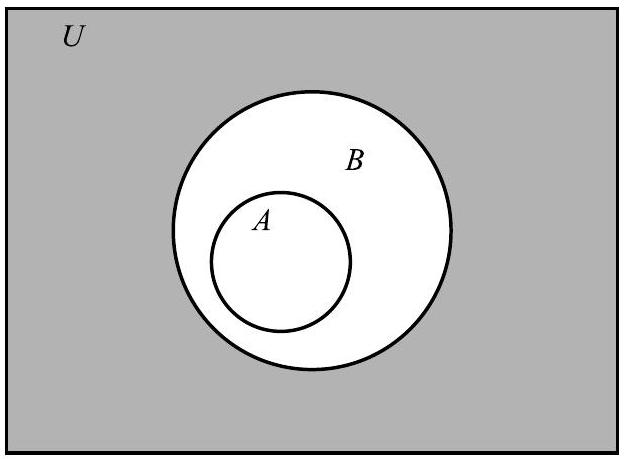
Draw a Venn diagram for two sets, and , with the assumption that is a subset of . On this Venn diagram, lightly shade the area corresponding to . Then, determine the region on the Venn diagram that corresponds to . What appears to be the relationship between and ? Explain.
-
2.
Draw a general Venn diagram for two sets, and . First determine the region that corresponds to the set and then, on the Venn diagram, shade the region corresponding to and shade the region corresponding to . What appears to be the relationship between these two sets? Explain.
In this section, we will learn how to prove certain relationships about sets. Two of the most basic types of relationships between sets are the equality relation and the subset relation. So if we are asked a question of the form, "How are the sets and related?", we can answer the question if we can prove that the two sets are equal or that one set is a subset of the other set. There are other ways to answer this, but we will concentrate on these two for now. This is similar to asking a question about how two real numbers are related. Two real numbers can be related by the fact that they are equal or by the fact that one number is less than the other number.
5.2.3 The Choose-an-Element Method
The method of proof we will use in this section can be called the choose-anelement method. This method was introduced in Beginning Activity 1. This method is frequently used when we encounter a universal quantifier in a statement in the backward process. This statement often has the form
For each element with a given property, something happens.
Since most statements with a universal quantifier can be expressed in the form of a conditional statement, this statement could have the following equivalent form:
If an element has a given property, then something happens.
We will illustrate this with the proposition from Beginning Activity 1. This proposition can be stated as follows:
there exists an integer such that
Since , this equation can be written in the form
By closure properties of the integers, is an integer. Hence, this last equation proves that must be even. Therefore, we have shown that if is an element of , then is an element of , and hence that .
Having proved that is a subset of , we can now ask if is actually equal to . The work we did in Beginning Activity 1 can help us answer this question. In that activity, we should have found several elements that are in but not in . For example, the integer 2 is in since 2 is even but since 2 is not a multiple of 6. Therefore, and we can also conclude that is a proper subset of .
One reason we do this in a "two-step" process is that it is much easier to work with the subset relation than the proper subset relation. The subset relation is defined by a conditional statement and most of our work in mathematics deals with proving conditional statements. In addition, the proper subset relation is a conjunction of two statements ( and ) and so it is natural to deal with the two parts of the conjunction separately.
5.2.4 Progress Check 5.8 (Subsets and Set Equality)
Let is a multiple of 9 and let is a multiple of 3.
-
1.
Is the set a subset of ? Justify your conclusion.
-
2.
Is the set equal to the set ? Justify your conclusion.
5.2.5 Progress Check 5.9 (Using the Choose-an-Element Method)
The Venn diagram in Beginning Activity 2 suggests that the following proposition is true.
Proposition 5.10. Let and be subsets of the universal set . If , then .
-
1.
The conclusion of the conditional statement is . Explain why we should try the choose-an-element method to prove this proposition.
-
2.
Complete the following know-show table for this proposition and explain exactly where the choose-an-element method is used.
| Step | Know | Reason |
| Hypothesis | ||
| Let . | Choose an arbitrary element of . | |
| P2 | ()(If , then ). | Definition of "subset" |
| Q1 | ( (If , then ). | |
| Definition of "subset" | ||
| Step | Show | Reason |
5.2.6 Proving Set Equality
One way to prove that two sets are equal is to use Theorem 5.2 and prove each of the two sets is a subset of the other set. In particular, let and be subsets of some universal set. Theorem 5.2 states that if and only if and .
In Beginning Activity 2, we created a Venn diagram that indicated that . Following is a proof of this result. Notice where the choose-an-element method is used in each case.
Proposition 5.11. Let and be subsets of some universal set. Then .
Proof. Let and be subsets of some universal set. We will prove that by proving that and that .
First, let . This means that
We know that an element is in () if and only if it is in and not in . Since , we conclude that or . However, we also know that and so we conclude that . This proves that
This means that , and hence we have proved that .
Now choose . This means that
We note that if and only if and and hence, if and only if or . Since we have proved that , we conclude that , and hence, we have established that and . This proves that if , then and hence, .
Since we have proved that and , we conclude that .
5.2.7 Progress Check 5.12 (Set Equality)
Prove the following proposition. To do so, prove each set is a subset of the other set by using the choose-an-element method.
Proposition 5.13. Let and be subsets of some universal set. Then .
5.2.8 Disjoint Sets
Earlier in this section, we discussed the concept of set equality and the relation of one set being a subset of another set. There are other possible relationships between two sets; one is that the sets are disjoint. Basically, two sets are disjoint if and only if they have nothing in common. We express this formally in the following definition.
Definition. Let and be subsets of the universal set . The sets and are said to be disjoint provided that .
For example, the Venn diagram in Figure 5.5 shows two sets and with . The shaded region is the region that represents . From the Venn diagram, it appears that . This means that and are disjoint. The preceding example suggests that the following proposition is true:
If we would like to prove this proposition, a reasonable "backward question" is, "How do we prove that a set (namely ) is equal to the empty set?"
This question seems difficult to answer since how do we prove that a set is empty? This is an instance where proving the contrapositive or using a proof by contradiction could be reasonable approaches. To illustrate these methods, let us assume the proposition we are trying to prove is of the following form:
If we choose to prove the contrapositive or use a proof by contradiction, we will assume that . These methods can be outlined as follows:
-
•
The contrapositive of "If , then " is, "If , then ." So in this case, we would assume and try to prove .
-
•
Using a proof by contradiction, we would assume and assume that . From these two assumptions, we would attempt to derive a contradiction.
One advantage of these methods is that when we assume that , then we know that there exists an element in the set . We can then use that element in the rest of the proof. We will prove one of the conditional statements for Proposition 5.14 by proving its contrapositive. The proof of the other conditional statement associated with Proposition 5.14 is Exercise (10).
Proposition 5.14. Let and be subsets of some universal set. Then if and only if .
Proof. Let and be subsets of some universal set. We will first prove that if , then , by proving its contrapositive. That is, we will prove
So assume that . We will prove that by proving that there must exist an element such that and .
Since , there exists an element that is in . This means that
Now, the fact that means that . Hence, we can conclude that
This means that , and hence, we have proved that if , then , and therefore, we have proved that if , then .
The proof that if , then is Exercise (10).
5.2.9 Progress Check 5.15 (Proving Two Sets Are Disjoint)
It has been noted that it is often possible to prove that two sets are disjoint by using a proof by contradiction. In this case, we assume that the two sets are not disjoint and hence, their intersection is not empty. Use this method to prove that the following two sets are disjoint.
5.2.10 A Final Comment
We have used the choose-an-element method to prove Propositions 5.7, 5.11, and 5.14. Proofs involving sets that use this method are sometimes referred to as element-chasing proofs. This name is used since the basic method is to choose an arbitrary element from one set and "chase it" until you prove it must be in another set.
5.2.11 Exercises for Section 5.2
-
1.
Let and let .
-
(a)
Is ? Justify your conclusion with a proof or a counterexample.
-
(b)
Is ? Justify your conclusion with a proof or a counterexample.
-
(a)
-
2.
Let , and be subsets of a universal set .
-
(a)
Draw a Venn diagram with and . Does it appear that
-
(b)
Prove the following proposition:
Note: This may seem like an obvious result. However, one of the reasons for this exercise is to provide practice at properly writing a proof that one set is a subset of another set. So we should start the proof by assuming that and . Then we should choose an arbitrary element of .
-
(a)
-
3.
Let and .
-
(a)
List at least five different elements of the set and at least five elements of the set .
-
(b)
Is ? Justify your conclusion with a proof or a counterexample.
-
(c)
Is ? Justify your conclusion with a proof or a counterexample.
-
(a)
-
4.
Let and .
-
(a)
List at least five different elements of the set and at least five elements of the set .
-
(b)
Is ? Justify your conclusion with a proof or a counterexample.
-
(c)
Is ? Justify your conclusion with a proof or a counterexample.
-
(a)
-
5.
In each case, determine if , or or none of these.
-
(a)
and divides .
-
(b)
and divides .
-
(c)
and .
-
(a)
-
6.
To prove the following set equalities, it may be necessary to use some of the properties of positive and negative real numbers. For example, it may be necessary to use the facts that:
-
•
The product of two real numbers is positive if and only if the two real numbers are either both positive or both negative.
-
•
The product of two real numbers is negative if and only if one of the two numbers is positive and the other is negative.
For example, if , then we can conclude that either (1) and or (2) and . However, in the first case, we must have and , and this is impossible. Therefore, we conclude that and , which means that .
Use the choose-an-element method to prove each of the following:
-
(a)
-
(b)
-
(c)
-
•
-
7.
Let and be subsets of some universal set . Prove each of the following:
-
(a)
-
(b)
e)
-
(c)
-
(d)
-
(e)
-
(a)
-
8.
Let and be subsets of some universal set . From Proposition 5.10, we know that if , then . Now prove the following proposition:
For all sets and that are subsets of some universal set if and only if .
-
9.
Is the following proposition true or false? Justify your conclusion with a proof or a counterexample.
For all sets and that are subsets of some universal set , the sets and are disjoint.
-
10.
Complete the proof of Proposition 5.14 by proving the following conditional statement:
Let and be subsets of some universal set. If , then .
-
11.
Let , and be subsets of some universal set . Are the following propositions true or false? Justify your conclusions.
-
(a)
If and and and are disjoint, then and are disjoint.
-
(b)
If and and and are disjoint, then and are disjoint.
-
(a)
-
12.
Let , and be subsets of a universal set . Prove:
-
(a)
If , then .
-
(a)
If , then .
-
(a)
-
13.
Let , and be subsets of a universal set . Are the following propositions true or false? Justify your conclusions.
-
(a)
If , then .
-
(b)
If , then .
-
(c)
If , then .
-
(d)
If , then .
-
(e)
If and , then .
-
(a)
-
14.
Prove the following proposition:
For all sets , and that are subsets of some universal set, if and , then .
-
15.
Are the following biconditional statements true or false? Justify your conclusion. If a biconditional statement is found to be false, you should clearly determine if one of the conditional statements within it is true and provide a proof of this conditional statement.
-
(a)
For all subsets and of some universal set if and only if .
-
(b)
For all subsets and of some universal set if and only if .
-
(c)
For all subsets and of some universal set if and only if .
-
(d)
For all subsets , and of some universal set if and only if or .
-
(e)
For all subsets , and of some universal set if and only if and .
-
(a)
-
16.
Let , and be subsets of some universal set. Assume that
-
(a)
;
-
(b)
; and
-
(c)
.
-
(a)
Using assumption
-
(b)
, what conclusion(s) can be made if it is known that ?
-
(c)
Using assumption (ii), what conclusion(s) can be made if it is known that ?
-
(d)
Using all three assumptions, either prove that or explain why it is not possible to do so.
-
(a)
-
17.
Evaluation of Proofs.
See the instructions for Exercise (19) from Section 3.1.
-
(a)
Let , and be subsets of some universal set. If and , then .
Proof. We assume that , and are subsets of some universal set and that and . This means that there exists an element in that is not in and there exists an element that is in and not in . Therefore, and , and we have proved that .
-
(b)
Let , and be subsets of some universal set. If , then .
Proof. We assume that and will prove that . We will first prove that .
So let . If , then , and hence, . From this we can conclude that . If , then , and hence, . However, since , we may conclude that . Therefore, .
The proof that may be done in a similar manner. Hence, . -
(c)
Let , and be subsets of some universal set. If and , then .
Proof. Assume that and . Since , there exists an element such that and . Since , we may conclude that . Hence, and , and we have proved that .
-
(a)
5.2.12 Explorations and Activities
-
18.
Using the Choose-an-Element Method in a Different Setting. We have used the choose-an-element method to prove results about sets. This method, however, is a general proof technique and can be used in settings other than set theory. It is often used whenever we encounter a universal quantifier in a statement in the backward process. Consider the following proposition.
Proposition 5.16. Let , and be integers with . If divides and divides , then for all integers and divides .
-
1.
Whenever we encounter a new proposition, it is a good idea to explore the proposition by looking at specific examples. For example, let , and . In this case, and . In each of the following cases, determine the value of and determine if divides .
-
(a)
-
(b)
-
(c)
-
(d)
-
(e)
-
(f)
-
(a)
-
2.
Repeat Part (18a) with , and .
Notice that the conclusion of the conditional statement in this proposition involves the universal quantifier. So in the backward process, we would have
For all integers and divides .The "elements" in this sentence are the integers and . In this case, these integers have no "given property" other than that they are integers. The "something that happens" is that divides . This means that in the forward process, we can use the hypothesis of the proposition and choose integers and . That is, in the forward process, we could have
, and are integers with divides and divides .P1: Let and let .
-
3.
Complete the following proof of Proposition 5.16.
Proof. Let , and be integers with , and assume that divides and divides . We will prove that for all integers and divides .
So let and let . Since divides , there exists an integer such that ….