5 Set Theory
5.5 Indexed Families of Sets
5.5.1 Beginning Activity 1 (The Union and Intersection of a Family of Sets)
In Section 5.3, we discussed various properties of set operations. We will now focus on the associative properties for set union and set intersection. Notice that the definition of "set union" tells us how to form the union of two sets. It is the associative law that allows us to discuss the union of three sets. Using the associate law, if , and are subsets of some universal set, then we can define to be or . That is,
For this activity, the universal set is and we will use the following four sets:
.
-
1.
Use the roster method to specify the sets , and .
-
2.
Use the roster method to specify each of the following sets. In each case, be sure to follow the order specified by the parentheses.
-
(a)
-
(b)
-
(c)
-
(d)
-
(e)
-
(f)
-
(g)
-
(h)
-
(a)
-
3.
Based on the work in Part (2), does the placement of the parentheses matter when determining the union (or intersection) of these four sets? Does this make it possible to define and ?
We have already seen that the elements of a set may themselves be sets. For example, the power set of a set , is the set of all subsets of . The phrase, "a set of sets" sounds confusing, and so we often use the terms collection and family when we wish to emphasize that the elements of a given set are themselves sets. We would then say that the power set of is the family (or collection) of sets that are subsets of .
One of the purposes of the work we have done so far in this activity was to show that it is possible to define the union and intersection of a family of sets.
Definition. Let be a family of sets. The union of is defined as the set of all elements that are in at least one of the sets in . We write
The intersection of is defined as the set of all elements that are in all of the sets in . That is,
For example, consider the four sets , and used earlier in this activity and the sets
We can then consider the following families of sets: and .
-
1.
Explain why
and use your work in (1), (2), and (3) to determine and .
-
2.
Use the roster method to specify and .
-
3.
Use the roster method to specify the sets and . Remember that the universal set is .
5.5.2 Beginning Activity 2 (An Indexed Family of Sets)
We often use subscripts to identify sets. For example, in Beginning Activity 1, instead of using , and as the names of the sets, we could have used , , and . When we do this, we are using the subscript as an identifying tag, or index, for each set. We can also use this idea to specify an infinite family of sets. For example, for each natural number , we define
So if we have a family of sets , we use the notation to mean the same thing as .
-
1.
Determine and .
We can see that with the use of subscripts, we do not even have to define the family of sets . We can work with the infinite family of sets
and use the subscripts to indicate which sets to use in a union or an intersection.
-
4.
Use the roster method to specify each of the following pairs of sets. The universal set is .
-
(a)
and
-
(b)
and
-
(c)
and
-
(d)
and
-
(a)
5.5.3 The Union and Intersection of an Indexed Family of Sets
One of the purposes of the beginning activities was to show that we often encounter situations in which more than two sets are involved, and it is possible to define the union and intersection of more than two sets. In Beginning Activity 2, we also saw that it is often convenient to "index" the sets in a family of sets. In particular, if is a natural number and is a family of sets, then the union of these sets, denoted by or , is defined as
We can also define the intersection of these sets, denoted by or , as
We can also extend this idea to define the union and intersection of a family that consists of infinitely many sets. So if , then
5.5.4 Progress Check 5.26 (An Infinite Family of Sets)
For each natural number , let . For example,
and
Determine each of the following sets:
-
1.
-
2.
-
3.
-
4.
-
5.
-
6.
In all of the examples we have studied so far, we have used or a subset of to index or label the sets in a family of sets. We can use other sets to index or label sets in a family of sets. For example, for each real number , we can define to be the closed interval . That is,
So we make the following definition. In this definition, is the uppercase Greek letter lambda and is the lowercase Greek letter alpha.
Definition. Let be a nonempty set and suppose that for each , there is a corresponding set . The family of sets is called an indexed family of sets indexed by . Each is called an index and is called an indexing set.
5.5.5 Progress Check 5.27 (Indexed Families of Sets)
In each of the indexed families of sets that we seen so far, if the indices were different, then the sets were different. That is, if is an indexing set for the family of sets , then if and , then . (Note: The letter is the Greek lowercase beta.)
-
1.
Let , and for each , let , and let . Determine , and .
-
2.
Is the following statement true or false for the indexed family in (1)?
For all , if , then .
-
3.
Now let . For each , define . Is the following statement true for the indexed family of sets ?
For all , if , then .
We now restate the definitions of the union and intersection of a family of sets for an indexed family of sets.
Definition. Let be a nonempty indexing set and let be an indexed family of sets. The union over is defined as the set of all elements that are in at least one of sets , where . We write
The intersection over is the set of all elements that are in all of the sets for each . That is,
5.5.6 Example 5.28 (A Family of Sets Indexed by the Positive Real Numbers)
For each positive real number , let be the interval . That is,
If we let be the set of positive real numbers, then we have a family of sets indexed by . We will first determine the union of this family of sets. Notice that for each , and if is a real number with , then . Also notice that if and , then for each . With these observations, we conclude that
To determine the intersection of this family, notice that
-
•
if and , then for each ;
-
•
if and , then for each ; and
-
•
if and , then if we let and .
From these observations, we conclude that
5.5.7 Progress Check 5.29 (A Continuation of Example 5.28)
Using the family of sets from Example 5.28, for each , we see that
Use the results from Example 5.28 to help determine each of the following sets. For each set, use either interval notation or set builder notation.
-
1.
-
2.
-
3.
-
4.
5.5.8 Properties of Union and Intersection
In Theorem 5.30, we will prove some properties of set operations for indexed families of sets. Some of these properties are direct extensions of corresponding properties for two sets. For example, we have already proved De Morgan’s Laws for two sets in Theorem 5.20. The work in the beginning activities and Progress Check 5.29 suggests that we should get similar results using set operations with an indexed family of sets. For example, in Beginning Activity 2, we saw that
Theorem 5.30. Let be a nonempty indexing set and let be an indexed family of sets, each of which is a subset of some universal set . Then
-
1.
For each .
-
2.
For each .
-
3.
-
4.
Parts (3) and (4) are known as De Morgan’s Laws.
Proof. We will prove Parts (1) and (3). The proofs of Parts (2) and (4) are included in Exercise (4). So we let be a nonempty indexing set and let be an indexed family of sets. To prove Part (1), we let and note that if , then , for all . Since is one element in , we may conclude that . This proves that .
To prove Part (3), we will prove that each set is a subset of the other set. We first let . This means that , and this means that
there exists a such that .
Hence, , which implies that . Therefore, we have proved that
| (1) |
We now let . This means that there exists a such that or . However, since , we may conclude that and, hence, . This proves that
| (2) |
Using the results in (1) and (2), we have proved that .
Many of the other properties of set operations are also true for indexed families of sets. Theorem 5.31 states the distributive laws for set operations.
Theorem 5.31. Let be a nonempty indexing set, let be an indexed family of sets, and let be a set. Then
-
1.
, and
-
2.
.
The proof of Theorem 5.31 is Exercise (5).
5.5.9 Pairwise Disjoint Families of Sets
In Section 5.2, we defined two sets and to be disjoint provided that . In a similar manner, if is a nonempty indexing set and is an indexed family of sets, we can say that this indexed family of sets is disjoint
provided that . However, we can use the concept of two disjoint sets to define a somewhat more interesting type of "disjointness" for an indexed family of sets.
Definition. Let be a nonempty indexing set, and let be an indexed family of sets. We say that is pairwise disjoint provided that for all and in , if , then .
5.5.10 Progress Check 5.32 (Disjoint Families of Sets)
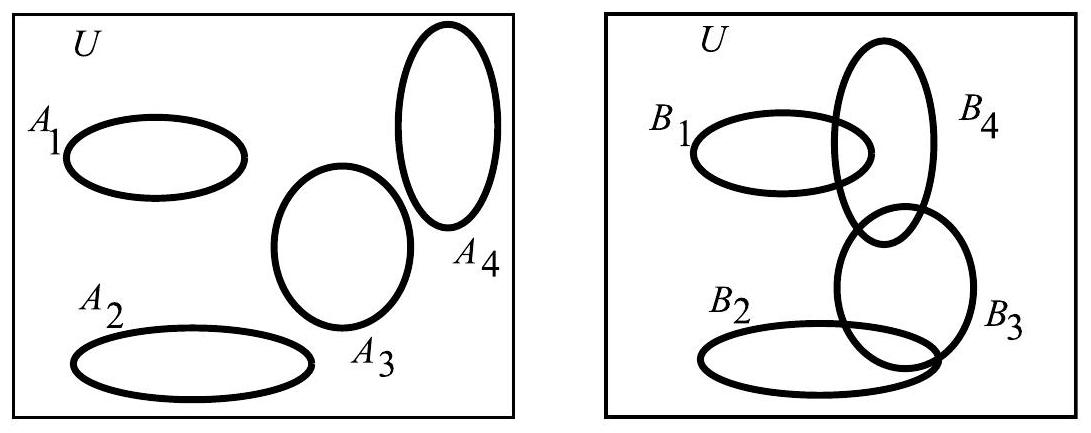
Figure 5.7 shows two families of sets,
-
1.
Is the family of sets a disjoint family of sets? A pairwise disjoint family of sets?
-
2.
Is the family of sets a disjoint family of sets? A pairwise disjoint family of sets?
Now let the universal set be . For each , let , and let .
-
5.
Is the family of sets a disjoint family of sets? A pairwise disjoint family of sets?
5.5.11 Exercises for Section 5.5
-
1.
For each natural number , let . Use the roster method to specify each of the following sets:
-
(a)
-
(b)
-
(c)
-
(d)
-
(e)
-
(f)
-
(a)
-
2.
For each natural number , let . Assuming the universal set is , use the roster method or set builder notation to specify each of the following sets:
-
(a)
-
(b)
-
(c)
-
(d)
-
(e)
-
(f)
-
(g)
-
(h)
-
(a)
-
3.
For each positive real number , define to be the closed interval . That is,
Let . Use either interval notation or set builder notation to specify each of the following sets:
-
(a)
-
(b)
-
(c)
-
(d)
-
(e)
-
(f)
-
(a)
-
4.
Prove Parts (2) and (4) of Theorem 5.30. Let be a nonempty indexing set and let be an indexed family of sets.
-
(a)
For each .
-
(b)
-
(a)
-
5.
Prove Theorem 5.31. Let be a nonempty indexing set, let be an indexed family of sets, and let be a set. Then
-
(a)
, and
-
(b)
.
-
(a)
-
6.
Let and be nonempty indexing sets. (Note: The letter is the uppercase Greek letter gamma.) Also, let and be indexed families of sets. Use the distributive laws in Exercise (5) to:
-
(a)
Write as a union of intersections of two sets.
-
(b)
Write as an intersection of unions of two sets.
-
(a)
-
7.
Let be a nonempty indexing set and let be an indexed family of sets. Also, assume that and . Prove that
-
(a)
-
(b)
-
(a)
-
8.
Let be a nonempty indexing set and let be an indexed family of sets.
-
(a)
Prove that if is a set such that for every , then .
-
(b)
Prove that if is a set such that for every , then .
-
(a)
-
9.
For each natural number , let . Prove that is a pairwise disjoint family of sets and that .
-
10.
For each natural number , let . Determine if the following statements are true or false. Justify each conclusion.
-
(a)
For all , if , then .
-
(b)
-
(a)
-
11.
Give an example of an indexed family of sets such all three of the following conditions are true:
-
(a)
For each ;
-
(b)
For each , if , then ; and
-
(c)
.
-
(a)
-
12.
Let be a nonempty indexing set, let be an indexed family of sets, and let be a set. Use the results of Theorem 5.30 and Theorem 5.31 to prove each of the following:
-
(a)
-
(b)
-
(c)
-
(d)
-
(a)
5.5.12 Explorations and Activities
-
13.
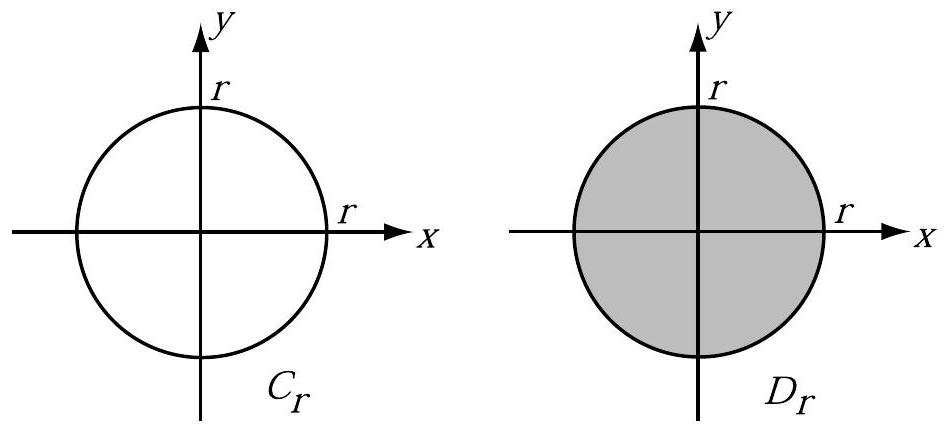
An Indexed Family of Subsets of the Cartesian Plane. Let be the set of nonnegative real numbers, and for each , let
If , then the set is the circle of radius with center at the origin as shown in Figure 5.8, and the set is the shaded disk (including the boundary) shown in Figure 5.8.
-
1.
Determine and .
-
2.
Determine and .
-
3.
Determine and .
-
4.
Let , and . Are any of these indexed families of sets pairwise disjoint? Explain.
Now let be the closed interval and let be the closed interval .
-
5.
Determine , and .
-
6.
Determine , and .
-
7.
Determine , and .
-
8.
Determine , and .
-
9.
Use De Morgan’s Laws to explain the relationship between your answers in Parts (13g) and (13h).
5.6 Chapter 5 Summary
5.6.1 Important Definitions
-
•
Equal sets, Section 2.3
-
•
Subset, Section 2.3
-
•
Proper subset, Section 5.1
-
•
Power set, Section 5.1
-
•
Cardinality of a finite set, Section 5.1
-
•
Intersection of two sets, Section 5.1
-
•
Union of two sets, Section 5.1
-
•
Set difference, Section 5.1
-
•
Complement of a set, Section 5.1
-
•
Disjoint sets, Section 5.2
-
•
Cartesian product of two sets, Section 5.4
-
•
Ordered pair, Section 5.4
-
•
Union over a family of sets, Section 5.5
-
•
Intersection over a family of sets, Section 5.5
-
•
Indexing set, Section 5.5
-
•
Indexed family of sets, Section 5.5
-
•
Union over an indexed family of sets, Section 5.5
-
•
Intersection over an indexed family of sets, Section 5.5
-
•
Pairwise disjoint family of sets, Section 5.5
5.6.2 Important Theorems and Results about Sets
-
•
Theorem 5.5. Let be a nonnegative integer and let be a subset of some universal set. If is a finite set with elements, then has subsets. That is, if , then .
-
•
Theorem 5.18. Let , and be subsets of some universal set . Then all of the following equalities hold.
| Properties of the Empty Set | |
|---|---|
| and the Universal Set | |
| Idempotent Laws | |
| Commutative Laws | |
| Associative Laws | |
Distributive Laws
-
•
Theorem 5.20. Let and be subsets of some universal set . Then the following are true:
| Basic Properties |
|
||
|---|---|---|---|
| Empty Set, Universal Set |
|
||
| De Morgan’s Laws |
|
||
| Subsets and Complements | if and only if . |
-
•
Theorem 5.25. Let , and be sets. Then
-
1.
-
2.
-
3.
-
4.
-
5.
-
6.
-
7.
If , then .
-
8.
If , then .
-
•
Theorem 5.30. Let be a nonempty indexing set and let be an indexed family of sets. Then
-
1.
For each .
-
2.
For each .
-
3.
-
4.
Parts (3) and (4) are known as De Morgan’s Laws.
-
•
Theorem 5.31. Let be a nonempty indexing set, let be an indexed family of sets, and let be a set. Then
-
1.
, and
-
2.
.
5.6.3 Important Proof Method: The Choose-an-Element Method
The choose-an-element method is frequently used when we encounter a universal quantifier in a statement in the backward process of a proof. This statement often has the form
For each element with a given property, something happens.
In the forward process of the proof, we then we choose an arbitrary element with the given property.
Whenever we choose an arbitrary element with a given property, we are not selecting a specific element. Rather, the only thing we can assume about the element is the given property.