6 Functions
6.6 Functions Acting on Sets
6.6.1 Beginning Activity 1 (Functions and Sets)
Let and . Define by
-
1.
Let and . Notice that and are subsets of . Use the roster method to specify the elements of the following two subsets of :
-
(a)
-
(b)
-
(a)
-
2.
Let and . Notice that and are subsets of . Use the roster method to specify the elements of the following two subsets of :
-
(a)
-
(b)
-
(a)
Now let be defined by , for each .
-
1.
Let . Use the roster method to specify the elements of the set .
-
2.
Use the roster method to specify the elements of each of the following sets:
-
(a)
-
(b)
-
(c)
-
(d)
-
(a)
-
3.
Let . Use the roster method to specify the elements of the set .
6.6.2 Beginning Activity 2 (Functions and Intervals)
Let be defined by , for each .
-
1.
We will first determine where maps the closed interval . (Recall that .) That is, we will describe, in simpler terms, the set . This is the set of all images of the real numbers in the closed interval .
-
(a)
Draw a graph of the function using .
-
(b)
On the graph, draw the vertical lines and from the -axis to the graph. Label the points and on the graph.
-
(c)
Now draw horizontal lines from the points and to the -axis. Use this information from the graph to describe the set in simpler terms. Use interval notation or set builder notation.
-
(a)
-
2.
We will now determine all real numbers that maps into the closed interval . That is, we will describe the set in simpler terms. This is the set of all preimages of the real numbers in the closed interval .
-
(a)
Draw a graph of the function using .
-
(b)
On the graph, draw the horizontal lines and from the -axis to the graph. Label all points where these two lines intersect the graph.
-
(c)
Now draw vertical lines from the points in Part (2) to the -axis, and then use the resulting information to describe the set in simpler terms. (You will need to describe this set as a union of two intervals. Use interval notation or set builder notation.)
-
(a)
6.6.3 Functions Acting on Sets
In our study of functions, we have focused on how a function "maps" individual elements of its domain to the codomain. We also studied the preimage of an individual element in its codomain. For example, if is defined by , for each , then
-
•
. We say that maps 2 to 4 or that 4 is the image of 2 under the function .
-
•
Since implies that or , we say that the preimages of 4 are 2 and -2 or that the set of preimages of 4 is .
For a function , the next step is to consider subsets of or and what corresponds to them in the other set. We did this in the beginning activities. We will give some definitions and then revisit the examples in the beginning activities in light of these definitions. We will first consider the situation where is a subset of and consider the set of outputs whose inputs are from . This will be a subset of .
Definition. Let . If , then the image of under is the set , where
If there is no confusion as to which function is being used, we call the image of .
We now consider the situation in which is a subset of and consider the subset of consisting of all elements of whose outputs are in .
Definition. Let . If , then the preimage of under is the set , where
If there is no confusion as to which function is being used, we call the preimage of . The preimage of the set under is also called the inverse image of under .
Notice that the set is defined whether or not is a function.
6.6.4 Progress Check 6.30 (Beginning Activity 1 Revisited)
Let and . Define by
Let and .
Use your work in Beginning Activity 1 to determine each of the following sets:
-
1.
-
2.
-
3.
-
4.
6.6.5 Example 6.31 (Images and Preimages of Sets)
Let be defined by , for each . The following results are based on the examples in Beginning Activity 1 and Beginning Activity 2.
-
•
Let . Then .
-
•
Let . Then .
The graphs from Beginning Activity 2 illustrate the following results:
-
•
If is the closed interval [1,2], then the image of the set is
-
•
If is the closed interval , then the preimage of the set is
6.6.6 Set Operations and Functions Acting on Sets
We will now consider the following situation: Let and be sets and let be a function from to . Also, let and be subsets of and let and be subsets of . In the remainder of this section, we will consider the following situations and answer the questions posed in each case.
-
•
The set is a subset of and so is a subset of . In addition, and are subsets of . Hence, is a subset of .
Is there any relationship between and ?
-
•
The set is a subset of and so is a subset of . In addition, and are subsets of . Hence, is a subset of .
Is there any relationship between and ? -
•
The set is a subset of and so is a subset of . In addition, and are subsets of . Hence, is a subset of .
Is there any relationship between the sets and ?
-
•
The set is a subset of and so is a subset of . In addition, and are subsets of . Hence, is a subset of .
Is there any relationship between the sets and ?
These and other questions will be explored in the next progress check.
6.6.7 Progress Check 6.32 (Set Operations and Functions Acting on Sets)
In Section 6.2, we introduced functions involving congruences. For example, if we let
then we can define by , where and . Moreover, we shortened this notation to
We will use the following subsets of :
-
1.
Verify that , and . Then determine , and .
-
2.
Determine , and .
-
3.
For each of the following, determine the two subsets of and then determine if there is a relationship between the two sets. For example, and since , we see that .
-
(a)
and
-
(b)
and
-
(c)
and
-
(d)
and
-
(a)
-
4.
Notice that is a subset of the codomain, . Consequently, is a subset of the domain, . Is there any relation between and in this case?
-
5.
Notice that is a subset of the domain, . Consequently, is a subset of the codomain, . Is there any relation between and in this case?
6.6.8 Example 6.33 (Set Operations and Functions Acting on Sets)
Define by for all . It will be helpful to use the graph shown in Figure 6.11.
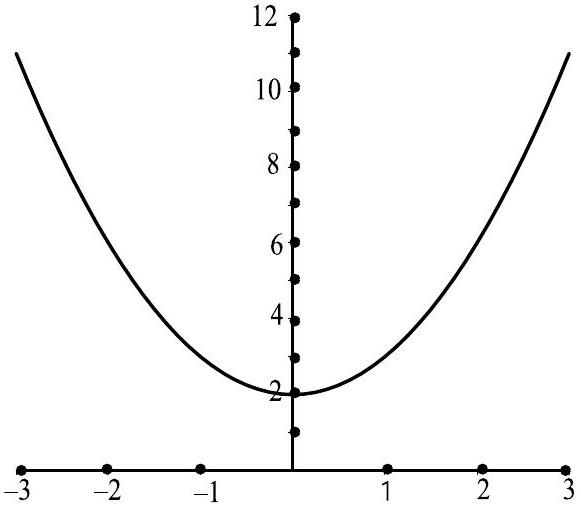
We will use the following closed intervals:
-
1.
Verify that , and that .
-
2.
-
(a)
Explain why and . So in this case, .
-
(b)
Explain why and . So in this case, .
-
(c)
Explain why and . So in this case, .
-
(d)
Explain why and . So in this case, .
-
(a)
-
3.
Recall that . Notice is a subset of the codomain, . Explain why . Since is a subset of the domain, , we see that in this case, .
-
4.
Recall that . Notice that is a subset of the domain, . Explain why . Since is a subset of the codomain, , we see that in this case .
The examples in Progress Check 6.32 and Example 6.33 were meant to illustrate general results about how functions act on sets. In particular, we investigated how the action of a function on sets interacts with the set operations of intersection and union. We will now state the theorems that these examples were meant to illustrate. Some of the proofs will be left as exercises.
Theorem 6.34. Let be a function and let and be subsets of . Then
-
1.
-
2.
Proof. We will prove Part (1). The proof of Part (2) is Exercise (5).
Assume that is a function and let and be subsets of . We will prove that by proving that for all , if , then .
We assume that . This means that there exists an such that . Since , we conclude that and .
-
•
Since and , we conclude that .
-
•
Since and , we conclude that .
Since and . This proves that if , then . Hence .
Theorem 6.35. Let be a function and let and be subsets of . Then
-
1.
-
2.
Proof. We will prove Part (2). The proof of Part (1) is Exercise (6).
Assume that is a function and that and are subsets of . We will prove that by proving that each set is a subset of the other.
We start by letting be an element of . This means that is an element of . Hence,
In the case where , we conclude that , and hence that . In the case where , we see that , and hence that . So in both cases, , and we have proved that .
We now let . This means that
-
•
In the case where , we conclude that and hence that . This means that .
-
•
Similarly, when , it follows that and hence that . This means that .
These two cases prove that if , then . Therefore, .
Since we have now proved that each of the two sets is a subset of the other set, we can conclude that .
Theorem 6.36. Let be a function and let be a subset of and let be a subset of . Then
-
1.
-
2.
Proof. We will prove Part (1). The proof of Part (2) is Exercise (7).
To prove Part (1), we will prove that for all , if , then . So let . Then, by definition, . We know that , and so . Notice that
Since , we use this to conclude that . This proves that if , then , and hence that .
6.6.9 Exercises 6.6
-
1.
Let , let and be subsets of , and let and be subsets of . For and , carefully explain what it means to say that
-
(a)
-
(b)
-
(c)
-
(d)
-
(e)
-
(f)
-
(g)
-
(h)
-
(a)
-
2.
Let by . Let
.Find each of the following:
-
(a)
-
(b)
-
(c)
-
(d)
-
(e)
-
(f)
-
(g)
-
(h)
-
(a)
-
3.
Let by , let , and let . Find
-
(a)
-
(b)
-
(c)
-
(d)
-
(a)
-
4.
-
(a)
Let . Define by for each . What is the range of the function and what is ? How do these two sets compare?
Now let and be sets and let be an arbitrary function from to .
-
(b)
Explain why .
-
(c)
Define a function by for all in . Prove that the function is a surjection.
-
(a)
-
5.
Prove Part (2) of Theorem 6.34. Let be a function and let and be subsets of . Then .
-
6.
Prove Part (1) of Theorem 6.35. Let be a function and let and be subsets of . Then .
-
7.
Prove Part (2) of Theorem 6.36.
Let be a function and let . Then .
-
8.
Let and let and be subsets of . Prove or disprove each of the following:
-
(a)
If , then .
-
(b)
If , then .
-
(a)
-
9.
Let and let and be subsets of . Prove or disprove each of the following:
-
(a)
If , then .
-
(b)
If , then .
-
(a)
-
10.
Prove or disprove:
If is a function and and are subsets of , then
.
Note: Part (1) of Theorem 6.34 states that . -
11.
Let be a function, let , and let .
-
(a)
Part (1) of Theorem 6.36 states that . Give an example where .
-
(b)
Part (2) of Theorem 6.36 states that . Give an example where .
-
(a)
-
12.
Is the following proposition true or false? Justify your conclusion with a proof or a counterexample.
If is an injection and , then . -
13.
Is the following proposition true or false? Justify your conclusion with a proof or a counterexample.
If is a surjection and , then . -
14.
Let . Prove that for all subsets and of if and only if is an injection.
6.7 Chapter 6 Summary
6.7.1 Important Definitions
-
•
Function, Section 6.1
-
•
Domain of a function, Section 6.1
-
•
Codomain of a function, Section 6.1
-
•
Image of under , Section 6.1
-
•
preimage of under , Section 6.1
-
•
Independent variable, Section 6.1
-
•
Dependent variable, Section 6.1
-
•
Range of a function, Section 6.1
-
•
Image of a function, Section 6.1
-
•
Equal functions, Section 6.1
-
•
Sequence, Section 6.2
-
•
Injection, Section 6.3
-
•
One-to-one function, Section 6.3
-
•
Surjection, Section 6.3
-
•
Onto function, Section 6.3
-
•
Bijection, Section 6.3
-
•
One-to-one and onto, Section 6.3
-
•
Composition of and , Section 6.4
-
•
Composite function, Section 6.4
-
•
followed by , Section 6.4
-
•
Inverse of a function, Section 6.5
-
•
Image of a set under a function, Section 6.6
-
•
Preimage of a set under a function, Section 6.6
6.7.2 Important Theorems and Results about Functions
-
•
Theorem 6.20. Let , and be nonempty sets and let and .
-
1.
If and are both injections, then is an injection.
-
2.
If and are both surjections, then is a surjection.
-
3.
If and are both bijections, then is a bijection.
-
•
Theorem 6.21. Let , and be nonempty sets and let and .
-
1.
If is an injection, then is an injection.
-
2.
If is a surjection, then is a surjection.
-
•
Theorem 6.22. Let and be nonempty sets and let be a subset of that satisfies the following two properties:
-
•
For every , there exists such that ; and
-
•
For every and every , if and , then .
If we use whenever , then is a function from to .
-
•
Theorem 6.25. Let and be nonempty sets and let . The inverse of is a function from to if and only if is a bijection.
-
•
Theorem 6.26. Let and be nonempty sets and let be a bijection. Then is a function, and for every and ,
-
•
Corollary 6.28. Let and be nonempty sets and let be a bijection. Then
-
1.
For every in .
-
2.
For every in .
-
•
Theorem 6.29. Let and be bijections. Then is a bijection and .
-
•
Theorem 6.34. Let be a function and let and be subsets of . Then
-
1.
-
2.
-
•
Theorem 6.35. Let be a function and let and be subsets of . Then
-
1.
-
2.
-
•
Theorem 6.36. Let be a function and let be a subset of and let be a subset of . Then
-
1.
-
2.