7 Equivalence Relations
7.1 Relations
7.1.1 Beginning Activity 1 (The United States of America)
Recall from Section 5.4 that the Cartesian product of two sets and , written , is the set of all ordered pairs (), where and . That is, and .
Let be the set of all states in the United States and let
For example, since California and Oregon have a land border, we can say that (California, Oregon) and (Oregon, California) . Also, since California and Michigan do not share a land border, (California, Michigan) and (Michigan, California) .
-
1.
Use the roster method to specify the elements in each of the following sets:
-
(a)
Michigan,
-
(b)
, Michigan
-
(c)
Wisconsin,
-
(a)
-
2.
Find two different examples of two ordered pairs, and such that , but , or explain why no such example exists. Based on this, is the following conditional statement true or false?
For all , if and , then .
-
3.
Is the following conditional statement true or false? Explain.
7.1.2 Beginning Activity 2 (The Solution Set of an Equation with Two Variables)
In Section 2.3, we introduced the concept of the truth set of an open sentence with one variable. This was defined to be the set of all elements in the universal set that can be substituted for the variable to make the open sentence a true proposition. Assume that and represent real numbers. Then the equation
is an open sentence with two variables. An element of the truth set of this open sentence (also called a solution of the equation) is an ordered pair () of real numbers so that when is substituted for and is substituted for , the predicate becomes a true statement (a true equation in this case). We can use set builder notation to describe the truth set of this equation with two variables as follows:
When a set is a truth set of an open sentence that is an equation, we also call the set the solution set of the equation.
-
1.
List four different elements of the set .
-
2.
The graph of the equation in the -coordinate plane is an ellipse. Draw the graph and explain why this graph is a representation of the truth set (solution set) of the equation .
-
3.
Describe each of the following sets as an interval of real numbers:
-
(a)
there exists a such that .
-
(b)
there exists an such that .
-
(a)
7.1.3 Introduction to Relations
In Section 6.1, we introduced the formal definition of a function from one set to another set. The notion of a function can be thought of as one way of relating the elements of one set with those of another set (or the same set). A function is a
special type of relation in the sense that each element of the first set, the domain, is "related" to exactly one element of the second set, the codomain.
This idea of relating the elements of one set to those of another set using ordered pairs is not restricted to functions. For example, we may say that one integer, , is related to another integer, , provided that is congruent to modulo 3. Notice that this relation of congruence modulo 3 provides a way of relating one integer to another integer. However, in this case, an integer is related to more than one other integer. For example, since
we can say that 5 is related to 5,5 is related to 2, and 5 is related to -1. Notice that, as with functions, each relation of the form involves two integers and and hence involves an ordered pair (), which is an element of .
Definition. Let and be sets. A relation from the set to the set is a subset of . That is, is a collection of ordered pairs where the first coordinate of each ordered pair is an element of , and the second coordinate of each ordered pair is an element of .
A relation from the set to the set is called a relation on the set . So a relation on the set is a subset of .
In Section 6.1, we defined the domain and range of a function. We make similar definitions for a relation.
Definition. If is a relation from the set to the set , then the subset of consisting of all the first coordinates of the ordered pairs in is called the domain of . The subset of consisting of all the second coordinates of the ordered pairs in is called the range of .
We use the notation for the domain of and for the range of . So using set builder notation,
7.1.4 Example 7.1 (Domain and Range)
A relation was studied in each of the beginning activities for this section. For
Beginning Activity 2, the set is a subset of and, hence, is a relation on . In Problem (3) of Beginning Activity 2, we actually determined the domain and range of this relation.
So from the results in Beginning Activity 2, we can say that the domain of the relation is the closed interval and the range of is the closed interval .
7.1.5 Progress Check 7.2 (Examples of Relations)
-
1.
Let .
-
(a)
Explain why is a relation on .
-
(b)
Find all values of such that . Find all values of such that .
-
(c)
What is the domain of the relation ? What is the range of ?
-
(d)
Since is a relation on , its elements can be graphed in the coordinate plane. Describe the graph of the relation .
-
(a)
-
2.
From Beginning Activity 1, is the set of all states in the United States, and
-
1.
Explain why is a relation on .
-
2.
What is the domain of the relation ? What is the range of the relation ?
-
3.
Are the following statements true or false? Justify your conclusions.
-
(a)
For all , if , then .
-
(b)
For all , if and , then .
-
(a)
7.1.6 Some Standard Mathematical Relations
There are many different relations in mathematics. For example, two real numbers can be considered to be related if one number is less than the other number. We
call this the "less than" relation on . If and is less than , we often write . As a set of ordered pairs, this relation is , where
With many mathematical relations, we do not write the relation as a set of ordered pairs even though, technically, it is a set of ordered pairs. Table 7.1 describes some standard mathematical relations.
| Name | Open Sentence | Relation as a Set of Ordered Pairs |
|---|---|---|
| The "less than" relation on | ||
| The "equality" relation on | ||
| The "divides" relation on | divides | |
| The "subset" relation on | ||
| The "element of" relation from to | ||
| The "congruence modulo " relation on |
7.1.7 Notation for Relations
The mathematical relations in Table 7.1 all used a relation symbol between the two elements that form the ordered pair in . For this reason, we often do the same thing for a general relation from the set to the set . So if is a relation from to , and and , we use the notation
In some cases, we will even use a generic relation symbol for defining a new relation or speaking about relations in a general context. Perhaps the most commonly
used symbol is "˜", read "tilde" or "squiggle" or "is related to." When we do this, we will write
7.1.8 Progress Check 7.3 (The Divides Relation)
Whenever we have spoken about one integer dividing another integer, we have worked with the "divides" relation on . In particular, we can write
In this case, we have a specific notation for "divides," and we write
-
1.
What is the domain of the "divides" relation? What is the range of the "divides" relation?
-
2.
Are the following statements true or false? Explain.
-
(a)
For every nonzero integer .
-
(b)
For all nonzero integers and , if , then .
-
(c)
For all nonzero integers , and , if and , then .
-
(a)
7.1.9 Functions as Relations
If we have a function , we can generate a set of ordered pairs that is a subset of as follows:
This means that is a relation from to . Since, , we know that
(1) For every , there exists a such that .
When , we write . In addition, to be a function, each input can produce only one output. In terms of ordered pairs, this means that there will never be two ordered pairs () and () in the function , where , and . We can formulate this as a conditional statement as follows:
(2) For every and every , if and , then .
This means that a function from to is a relation from to that satisfies conditions (1) and (2). (See Theorem 6.22 in Section 6.5.) Not every relation, however, will be a function. For example, consider the relation in Progress Check 7.2.
This relation fails condition (2) above since a counterexample comes from the facts that and and .
7.1.10 Progress Check 7.4 (A Set of Ordered Pairs)
Let . The set can then be considered to be relation on since it is a subset of .
-
1.
List five different ordered pairs that are in the set .
-
2.
Use the roster method to specify the elements of each of the following the sets:
-
(a)
-
(b)
-
(c)
-
(d)
-
(a)
-
3.
Since each real number produces only one value of for which , the set can be used to define a function from the set to . Draw a graph of this function.
7.1.11 Visual Representations of Relations
In Progress Check 7.4, we were able to draw a graph of a relation as a way to visualize the relation. In this case, the relation was a function from to . In addition, in Progress Check 7.2, we were also able to use a graph to represent a relation. In this case, the graph of the relation is a circle of radius 8 whose center is at the origin.
When is a relation from a subset of the real numbers to a subset of , we can often use a graph to provide a visual representation of the relation. This is especially true if the relation is defined by an equation or even an inequality. For example, if

7.1.12 Progress Check 7.5 (The Directed Graph of a Relation)
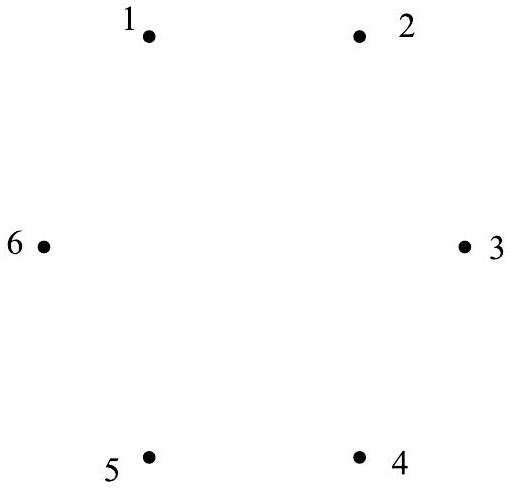
Let . Draw a directed graph for the following two relations on the set . For each relation, it may be helpful to arrange the vertices of as shown in Figure 7.3.
divides is even .
7.1.13 Exercises 7.1
-
1.
Let , and let be the set of ordered pairs defined by .
-
(a)
Use the roster method to list all the elements of . Explain why can be considered to be a relation from to .
-
(b)
Explain why is a relation from to .
-
(c)
What is the domain of ? What is the range of ?
-
(a)
-
2.
Let and let (so is a relation on ). Are the following statements true or false? Explain.
-
(a)
For each .
-
(b)
For every , if , then .
-
(c)
For every , if and , then .
-
(d)
is a function from to .
-
(a)
-
3.
Let be the set of all female citizens of the United States. Let be the relation on defined by
That is, means that is a daughter of .
-
(a)
Describe those elements of that are in the domain of .
-
(b)
Describe those elements of that are in the range of .
-
(c)
Is the relation a function from to ? Explain.
-
(a)
-
4.
Let be a nonempty set, and let be the "subset relation" on . That is,
-
(a)
Write the open sentence using standard subset notation.
-
(b)
What is the domain of this subset relation, ?
-
(c)
What is the range of this subset relation, ?
-
(d)
Is a function from to ? Explain.
-
(a)
-
5.
Let be a nonempty set, and let be the "element of" relation from to . That is,
-
(a)
What is the domain of this "element of" relation, ?
-
(b)
What is the range of this "element of" relation, ?
-
(c)
Is a function from to ? Explain.
-
(a)
-
6.
Let .
-
(a)
Determine the set of all values of such that , and determine the set of all values of such that .
-
(b)
Determine the domain and range of the relation and write each set using set builder notation.
-
(c)
Is the relation a function from to ? Explain.
-
(d)
Since is a relation on , its elements can be graphed in the coordinate plane. Describe the graph of the relation . Is the graph consistent with your answers in Exercises (6a) through (6c)? Explain.
-
(a)
-
7.
Repeat Exercise (6) using the relation on defined by
What is the connection between this relation and the relation in Exercise (6)?
-
8.
Determine the domain and range of each of the following relations on and sketch the graph of each relation.
-
(a)
-
(b)
-
(c)
-
(d)
-
(a)
-
9.
Let be the relation on where for all if and only if .
-
(a)
Use set builder notation to describe the relation as a set of ordered pairs.
-
(b)
Determine the domain and range of the relation .
-
(c)
Use the roster method to specify the set of all integers such that and the set of all integers such that .
-
(d)
If possible, find integers and such that , but .
-
(e)
If , use the roster method to specify the set of all such that .
-
(a)
-
10.
Let . This means that is the "less than" relation on .
-
(a)
What is the domain of the relation ?
-
(b)
What is the range of the relation ?
-
(c)
Is the relation a function from to ? Explain.
-
(a)
Note: Remember that a relation is a set. Consequently, we can talk about one relation being a subset of another relation. Another thing to remember is that the elements of a relation are ordered pairs.
7.1.14 Explorations and Activities
-
11.
The Inverse of a Relation. (The results of this section will be termed Theorem 7.6.) In Section 6.5, we introduced the inverse of a function. If and are nonempty sets and if is a function, then the inverse of , denoted by , is defined as
Now that we know about relations, we see that is always a relation from to . The concept of the inverse of a function is actually a special case of the more general concept of the inverse of a relation, which we now define.
Definition. Let be a relation from the set to the set . The inverse of , written and read " inverse," is the relation from to defined by
That is, is the subset of consisting of all ordered pairs () such that .
For example, let be the "divides" relation on . See Progress Check 7.3.
So