7 Equivalence Relations
7.2 Equivalence Relations
7.2.1 Beginning Activity 1 (Properties of Relations)
In previous mathematics courses, we have worked with the equality relation. For example, let be the relation on defined as follows: For all if and only if . We know this equality relation on has the following properties:
-
•
For each and so .
-
•
For all , if , then . That is, if , then .
-
•
For all , if and , then . That is, if and , then .
In mathematics, when something satisfies certain properties, we often ask if other things satisfy the same properties. Before investigating this, we will give names to these properties.
Definition. Let be a nonempty set and let be a relation on .
-
•
The relation is reflexive on provided that for each or, equivalently, .
-
•
The relation is symmetric provided that for every , if , then or, equivalently, for every , if , then .
-
•
The relation is transitive provided that for every , if and , then or, equivalently, for every , if and , then .
Before exploring examples, for each of these properties, it is a good idea to understand what it means to say that a relation does not satisfy the property. So let be a nonempty set and let be a relation on .
-
1.
Carefully explain what it means to say that the relation is not reflexive on the set .
-
2.
Carefully explain what it means to say that the relation is not symmetric.
-
3.
Carefully explain what it means to say that the relation is not transitive.
To illustrate these properties, we let and define the relations and on as follows:
-
1.
Draw a directed graph for the relation . Then explain why the relation is reflexive on , is not symmetric, and is not transitive.
-
2.
Draw a directed graph for the relation . Is the relation reflexive on ? Is the relation symmetric? Is the relation transitive? Explain.
7.2.2 Beginning Activity 2 (Review of Congruence Modulo )
-
1.
Let and let . In Section 3.1, we defined what it means to say that is congruent to modulo . Write this definition and state two different conditions that are equivalent to the definition.
-
2.
Explain why congruence modulo is a relation on .
-
3.
Carefully review Theorem 3.30 and the proofs given below it in Section 3.5. In terms of the properties of relations introduced in Beginning Activity 1, what does this theorem say about the relation of congruence modulo on the integers?
-
4.
Write a complete statement of Theorem 3.31 and Corollary 3.32.
-
5.
Write a proof of the symmetric property for congruence modulo . That is, prove the following:
Let and let . If , then .
7.2.3 Directed Graphs and Properties of Relations
In Section 7.1, we used directed graphs, or digraphs, to represent relations on finite sets. Three properties of relations were introduced in Beginning Activity 1 and will be repeated in the following descriptions of how these properties can be visualized on a directed graph.
Let be a nonempty set and let be a relation on .
-
•
The relation is reflexive on provided that for each or, equivalently, .
This means that if a reflexive relation is represented on a digraph, there would have to be a loop at each vertex, as is shown in the following figure.

-
•
The relation is symmetric provided that for every , if , then or, equivalently, for every , if , then .
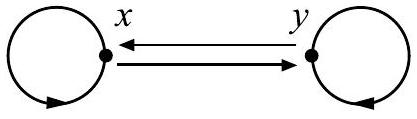
This means that if a symmetric relation is represented on a digraph, then anytime there is a directed edge from one vertex to a second vertex, there would be a directed edge from the second vertex to the first vertex, as is shown in the following figure.

-
•
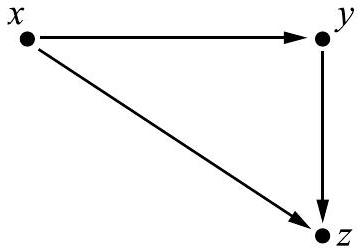
The relation is transitive provided that for every , if and , then or, equivalently, for every , if and , then . So if a transitive relation is represented by a digraph, then anytime there is a directed edge from a vertex to a vertex and a directed edge from to a vertex , there would be a directed edge from to .
In addition, if a transitive relation is represented by a digraph, then anytime there is a directed edge from a vertex to a vertex and a directed edge from to the vertex , there would be loops at and . These two situations are illustrated as follows:
7.2.4 Progress Check 7.7 (Properties of Relations)
Let and let be the following relation on :
Draw a directed graph for the relation and then determine if the relation is reflexive on , if the relation is symmetric, and if the relation is transitive.
7.2.5 Definition of an Equivalence Relation
In mathematics, as in real life, it is often convenient to think of two different things as being essentially the same. For example, when you go to a store to buy a cold soft drink, the cans of soft drinks in the cooler are often sorted by brand and type of soft drink. The Coca Colas are grouped together, the Pepsi Colas are grouped together, the Dr. Peppers are grouped together, and so on. When we choose a particular can of one type of soft drink, we are assuming that all the cans are essentially the same. Even though the specific cans of one type of soft drink are physically different, it makes no difference which can we choose. In doing this, we are saying that the cans of one type of soft drink are equivalent, and we are using the mathematical notion of an equivalence relation.
An equivalence relation on a set is a relation with a certain combination of properties that allow us to sort the elements of the set into certain classes. In this section, we will focus on the properties that define an equivalence relation, and in the next section, we will see how these properties allow us to sort or partition the elements of the set into certain classes.
Definition. Let be a nonempty set. A relation on the set is an equivalence relation provided that is reflexive, symmetric, and transitive. For , if is an equivalence relation on and , we say that is equivalent to .
Most of the examples we have studied so far have involved a relation on a small finite set. For these examples, it was convenient to use a directed graph to represent the relation. It is now time to look at some other type of examples, which may prove to be more interesting. In these examples, keep in mind that there is a subtle difference between the reflexive property and the other two properties. The reflexive property states that some ordered pairs actually belong to the relation , or some elements of are related. The reflexive property has a universal quantifier and, hence, we must prove that for all . Symmetry and transitivity, on
the other hand, are defined by conditional sentences. We often use a direct proof for these properties, and so we start by assuming the hypothesis and then showing that the conclusion must follow from the hypothesis.
7.2.6 Example 7.8 (A Relation that Is Not an Equivalence Relation)
Let be the relation on defined as follows:
For if and only if is a multiple of .
So if and only if there exists a such that .
-
•
The relation is reflexive on since for each and, hence, .
-
•
Notice that 4 M 2, but 4. So there exist integers and such that but . Hence, the relation is not symmetric.
-
•
Now assume that and . Then there exist integers and such that
Using the second equation to make a substitution in the first equation, we see that . Since , we have shown that is a multiple of and hence . Therefore, is a transitive relation.
The relation is reflexive on and is transitive, but since is not symmetric, it is not an equivalence relation on .
7.2.7 Progress Check 7.9 (A Relation that Is an Equivalence Relation)
Define the relation on as follows: For all if and only if . For example:
To prove that is reflexive on , we note that for all , . Since , we conclude that . Now prove that the relation is symmetric and transitive, and hence, that is an equivalence relation on .
7.2.8 Congruence Modulo n
One of the important equivalence relations we will study in detail is that of congruence modulo . We reviewed this relation in Beginning Activity 2 .
Theorem 3.30 tells us that congruence modulo is an equivalence relation on . Recall that by the Division Algorithm, if , then there exist unique integers and such that
Theorem 3.31 and Corollary 3.32 then tell us that . That is, is congruent modulo to its remainder when it is divided by . When we use the term "remainder" in this context, we always mean the remainder with that is guaranteed by the Division Algorithm. We can use this idea to prove the following theorem.
Theorem 7.10. Let and let . Then if and only if a and have the same remainder when divided by .
Proof. Let and let . We will first prove that if and have the same remainder when divided by , then . So assume that and have the same remainder when divided by , and let be this common remainder. Then, by Theorem 3.31,
Since congruence modulo is an equivalence relation, it is a symmetric relation. Hence, since , we can conclude that . Combining this with the fact that , we now have
We can now use the transitive property to conclude that . This proves that if and have the same remainder when divided by , then .
We will now prove that if , then and have the same remainder when divided by . Assume that , and let be the least nonnegative remainder when is divided by . Then and, by Theorem 3.31,
Now, using the facts that and , we can use the transitive property to conclude that
This means that there exists an integer such that or that
Since we already know that , the last equation tells us that is the least nonnegative remainder when is divided by . Hence we have proven that if , then and have the same remainder when divided by .
7.2.9 Examples of Other Equivalence Relations
-
1.
The relation on from Progress Check 7.9 is an equivalence relation.
-
2.
Let be a nonempty set. The equality relation on is an equivalence relation. This relation is also called the identity relation on and is denoted by , where
-
3.
Define the relation on as follows:
For if and only if there exists an integer such that .
We will prove that the relation is an equivalence relation on . The relation is reflexive on since for each .
Now, let and assume that . We will prove that . Since , there exists an integer such that
By multiplying both sides of this equation by -1, we obtain
Since , the last equation proves that . Hence, we have proven that if , then and, therefore, the relation is symmetric.
To prove transitivity, let and assume that and . We will prove that . Now, there exist integers and such that
By adding the corresponding sides of these two equations, we see that
By the closure properties of the integers, . So this proves that and, hence the relation is transitive.
We have now proven that is an equivalence relation on . This equivalence relation is important in trigonometry. If , then there exists an integer such that and, hence, . Since the sine and cosine functions are periodic with a period of , we see that
Therefore, when , each of the trigonometric functions have the same value at and .
-
4.
For an example from Euclidean geometry, we define a relation on the set of all lines in the plane as follows:
For if and only if is parallel to or .
We added the second condition to the definition of to ensure that is reflexive on . Theorems from Euclidean geometry tell us that if is parallel to , then is parallel to , and if is parallel to and is parallel to , then is parallel to . (Drawing pictures will help visualize these properties.) This tells us that the relation is reflexive, symmetric, and transitive and, hence, an equivalence relation on .
7.2.10 Progress Check 7.11 (Another Equivalence Relation)
Let be a finite, nonempty set and let be the power set of . Recall that consists of all subsets of . Define the relation on as follows:
For if and only if .
Review the definition of the cardinality of a finite set in Section 5.1. This relation states that two subsets of are equivalent provided that they have the same number of elements. Prove that is an equivalence relation on the power set .
7.2.11 Exercises 7.2
-
1.
Let and let . Is an equivalence relation on ? If not, is reflexive, symmetric, or transitive? Justify all conclusions.
-
2.
Let . For each of the following, draw a directed graph that represents a relation with the specified properties.
-
(a)
A relation on that is symmetric but not transitive
-
(b)
A relation on that is transitive but not symmetric
-
(c)
A relation on that is symmetric and transitive but not reflexive on
-
(d)
A relation on that is not reflexive on , is not symmetric, and is not transitive
-
(e)
A relation on , other than the identity relation, that is an equivalence relation on
-
(a)
-
3.
Let . The identity relation on is
Determine an equivalence relation on that is different from or explain why this is not possible.
-
4.
Let . Then is a relation on . Is an equivalence relation on ? If not, is reflexive, symmetric, or transitive? Justify all conclusions.
-
5.
A relation is defined on as follows: For all if and only if . Is an equivalence relation on ? If not, is reflexive, symmetric, or transitive? Justify all conclusions.
-
6.
Let be defined by for each . Define a relation on as follows:
For if and only if .
-
(a)
Is the relation an equivalence relation on ? Justify your conclusion.
-
(b)
Determine all real numbers in the set .
-
(a)
-
7.
Repeat Exercise (6) using the function that is defined by for each .
-
8.
-
(a)
Repeat Exercise (6a) using the function that is defined by for each .
-
(b)
Determine all real numbers in the set .
-
(a)
-
9.
Define the relation on as follows: For if and only if . In Progress Check 7.9, we showed that the relation is an equivalence relation on .
-
(a)
List four different elements of the set .
-
(b)
Use set builder notation (without using the symbol ) to specify the set C.
-
(c)
Use the roster method to specify the set .
-
(a)
-
10.
Let and be relations on defined as follows:
-
•
For if and only if 2 divides .
-
•
For if and only if 3 divides .
-
(a)
Is an equivalence relation on ? If not, is this relation reflexive, symmetric, or transitive?
-
(b)
Is an equivalence relation on ? If not, is this relation reflexive, symmetric, or transitive?
-
•
-
11.
Let be a finite, nonempty set and let be the power set of . That is, is the set of all subsets of . Define the relation on as follows: For if and only if . That is, the ordered pair is in the relation if and only if and are disjoint.
Is the relation an equivalence relation on ? If not, is it reflexive, symmetric, or transitive? Justify all conclusions.
-
12.
Let be a nonempty set and let be the power set of . That is, is the set of all subsets of .
For and in , define to mean that there exists a bijection . Prove that is an equivalence relation on .
Hint: Use results from Sections 6.4 and 6.5.
-
13.
Let and be relations on defined as follows:
-
•
For if and only if .
-
•
For if and only if .
-
(a)
Is an equivalence relation on ? If not, is this relation reflexive, symmetric, or transitive?
-
(b)
Is an equivalence relation on ? If not, is this relation reflexive, symmetric, or transitive?
-
•
-
14.
Let and be relations on defined as follows:
-
•
For if and only if .
-
•
For if and only if .
-
(a)
Is an equivalence relation on ? If not, is this relation reflexive, symmetric, or transitive?
-
(b)
Is an equivalence relation on ? If not, is this relation reflexive, symmetric, or transitive?
-
•
-
15.
Define the relation on as follows: For , if and only if .
-
(a)
Prove that is an equivalence relation on .
-
(b)
List four different elements of the set
-
(c)
Give a geometric description of the set .
-
(a)
-
16.
Evaluation of proofs. See the instructions for Exercise (19) from Section 3.1.
-
(a)
Proposition. Let be a relation on a set . If is symmetric and transitive, then is reflexive.
Proof. Let . If , then since is symmetric. Now, and , and since is transitive, we can conclude that . Therefore, is reflexive.
-
(b)
Proposition. Let be a relation on where for all if and only if . The relation is an equivalence relation on .
Proof. Assume . Then since . Therefore, is reflexive on . In addition, if , then , and if we multiply both sides of this congruence by 2, we get
This means that and hence, is symmetric.
We now assume that and . By adding the corresponding sides of these two congruences, we obtainHence, the relation is transitive and we have proved that is an equivalence relation on .
-
(a)
7.2.12 Explorations and Activities
-
17.
Other Types of Relations. In this section, we focused on the properties of a relation that are part of the definition of an equivalence relation. However, there are other properties of relations that are of importance. We will study two of these properties in this activity.
A relation on a set is a circular relation provided that for all , and in , if and , then .
-
1.
Carefully explain what it means to say that a relation on a set is not circular.
-
2.
Let . Draw a directed graph of a relation on that is circular and draw a directed graph of a relation on that is not circular.
-
3.
Let . Draw a directed graph of a relation on that is circular and not transitive and draw a directed graph of a relation on that is transitive and not circular.
-
4.
Prove the following proposition:
A relation on a set is an equivalence relation if and only if it is reflexive and circular.
A relation on a set is an antisymmetric relation provided that for all , if and , then .
-
5.
Carefully explain what it means to say that a relation on a set is not antisymmetric.
-
6.
Let . Draw a directed graph of a relation on that is antisymmetric and draw a directed graph of a relation on that is not antisymmetric.
-
7.
Are the following propositions true or false? Justify all conclusions.
-
•
If a relation on a set is both symmetric and antisymmetric, then is transitive.
-
•
If a relation on a set is both symmetric and antisymmetric, then is reflexive.
-
•